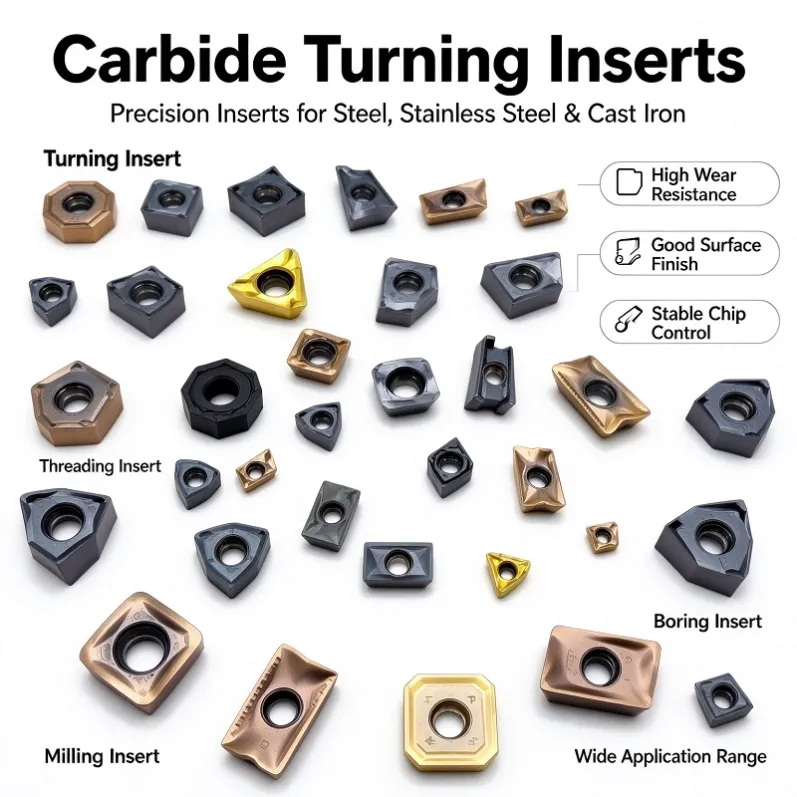
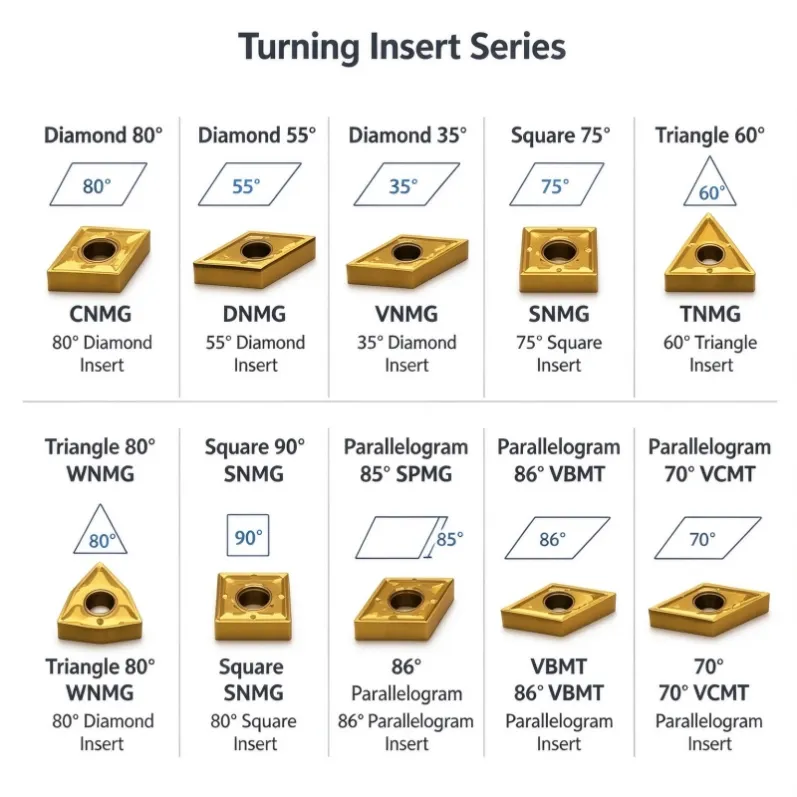
Turning / Threading / Milling Inserts
Carbide Turning Inserts
Cemented carbide inserts are the most widely used cutting tool materials in machining. They are sintered from tungsten carbide powder with cobalt binder. Featuring high hardness and excellent hot hardness, they can machine mild steel, hardened steel, stainless steel and other workpieces.
Specifications
- Machinable Hardness:
- HRC23~32
- Machining Range:
- Rough turning, Semi-finish turning, Finish turning
- Applicable Machine:
- CNC Lathe
Product Introduction
By the rotary motion of workpiece and reciprocating movement of cutting tool, most material allowance is removed to achieve target shape, dimension and precision. It can be used as pre-process before heat treatment.
1: Chipbreaker Geometry & Features
Chipbreaker | | | Application | Features |
|---|---|---|---|---|
BS |  |  | Profiling machining (Negative insert) | Recommended for profiling. 3-stage chip breaking points ensure stable chip control during profiling. Sharp cutting edge reduces cutting force and delivers superior surface finish. Inclined edge & wavy flank design enables smooth chip evacuation under variable depth of cut & pull turning. |
PA |  |  | Finish turning for steel | Recommended chipbreaker for steel finishing. Segmented chip breaker platform realizes reliable chip breaking under different depth of cut. Sharp cutting edge with positive inclination angle lowers cutting resistance and optimizes chip flow direction. |
PB |  |  | Semi-finish turning for steel | Recommended chipbreaker for steel semi-finishing. Combination of flat land and large rake angle on rake face balances cutting edge strength and sharpness. Large inclined angle at tip reduces cutting resistance. Wavy flank performs well on chip breaking for wall pull turning, ideal for profiling with variable cutting depth. |
PC |  |  | Medium turning for steel | Recommended chipbreaker for steel semi-finishing. Tapered cutting edge (narrow front, wide rear) provides wide chip breaking window. Double rake angle design for light cutting. Reinforced tip for strong resistance against crater wear. |
PL |  |  | Medium turning for steel | Recommended chipbreaker for steel semi-finishing. Tapered cutting edge (narrow front, wide rear) provides wide chip breaking window. Double rake angle design for light cutting. Reinforced tip for strong resistance against crater wear. |
PM |  |  | Rough turning for steel | Recommended chipbreaker for steel roughing. Small land near tip ensures good chip breaking under shallow cut and strengthens tool nose. Double rake angle design effectively reduces cutting resistance. |
2: Coating & Grades
Grade | Coating Type | Color | Coating composition | Coating Structure | Key Features |
|---|---|---|---|---|---|
SP3100 | CVD | Dual-color |  | Ultra-fine MT-TiCN, Al₂O₃ & smooth TiN coating, gradient carbide substrate | Excellent wear resistance. Suitable for finish & semi-finish turning of carbon steel and alloy steel. |
SP3200 | CVD | Dual-color |  | Fine MT-TiCN, Al₂O₃ & smooth TiN coating, tough gradient substrate | Balanced wear resistance & improved toughness. For semi-finish to light rough turning of steel & alloy steel under general conditions. |
SP3400 | CVD | Dual-color | 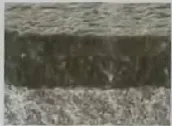 | Gradient substrate with high cubic phase content, special post-treated Al₂O₃ coating | Great plastic deformation resistance and toughness. Universal grade for semi-finish & rough turning of steel. |
SP3500 | CVD | Dual-color | 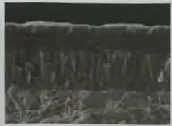 | Fine MT-TiCN + Al₂O₃ coating, gradient substrate with high chipping resistance | Designed for rough turning of steel & alloy steel under unstable cutting conditions. |
ZT6215 | CVD | Black | 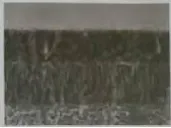 | Fine grain substrate + MT-TiCN + thick Al₂O₃ coating with special post-treatment | Improved edge strength & stable cutting performance. Especially for cast iron machining. |
DHQ8025(A) | PVD | Bronze Black | 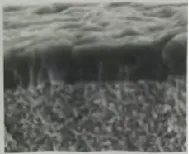 | Tough fine grain carbide substrate + AlTiN PVD coating | High edge strength and outstanding wear resistance. For light machining of steel & cast iron. |
DHQ8030(A) | PVD | Purple Bronze | 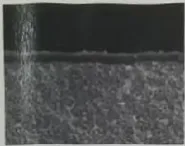 | Upgraded AlTiN+ coating, high wear & fracture resistant substrate | Excellent heat & oxidation resistance. High strength for stable cutting in varied working conditions. |
DHQ8815(H) | PVD | Purple Bronze | 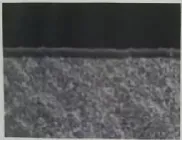 | Ultra-fine high cobalt substrate + thermally stable PVD coating | Low friction coefficient, high nano-hardness. Ideal for stainless steel turning. |
DHQ8810(A) | PVD | Bronze Black | 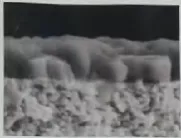 | High cobalt fine grain substrate + silicon-containing stable PVD coating | Low friction coefficient, high nano-hardness. |
DHQ8805(H) | PVD | Bronze Black | 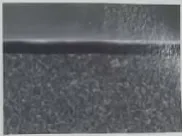 | High toughness fine grain substrate + thermally stable PVD coating | Low friction coefficient, high nano-hardness. |
Recommended Cutting Speed
ISO Material Group | Workpiece Material | HB | Tensile Strength(N/mm²) | AC152P (Vc, m/min)f:0.1 / 0.4 /0.6 mm/rev | AC252P (Vc, m/min)f:0.1 / 0.4 /0.6 mm/rev |
|---|---|---|---|---|---|
P | Unalloyed steel C≤0.25%, Annealed | 125 | 428 | 485 / 360 / 270 | 380 / 260 / 210 |
Unalloyed steel 0.25<C≤0.55%, Annealed | 190 | 639 | 370 / 270 / 210 | 280 / 200 / 150 | |
Unalloyed steel 0.25<C≤0.55%, Quenched &Tempered | 210 | 708 | 260 / 220 / 170 | 200 / 160 / 135 | |
Unalloyed steel C>0.55%, Annealed | 190 | 639 | 270 / 220 / 160 | 240 / 160 / 125 | |
Unalloyed steel C>0.55%, Quenched & Tempered | 300 | 1013 | 210 / 180 / 150 | 160 / 120 / 110 | |
Free-cutting steel, Annealed | 220 | 745 | 440 / 310 / 250 | 340 / 220 / 175 | |
Low alloy steel, Annealed | 175 | 591 | 350 / 260 / 220 | 240 / 175 / 135 | |
Low alloy steel, Quenched & Tempered | 285 | 1013 | 220 / 170 / 150 | 140 / 100 / 85 | |
Low alloy steel, Quenched & Tempered | 380 | 1282 | 160 / 120 / 100 | 100 / 70 / 55 | |
Low alloy steel, Quenched & Tempered | 430 | 1477 | 90 / 70 / — | — | |
High alloy tool steel, Annealed | 200 | 675 | 330 / 230 / 150 | 210 / 145 / 85 | |
High alloy tool steel, Quenched & Tempered | 300 | 1013 | 230 / 140 / 110 | 130 / 85 / 65 | |
High alloy tool steel, Quenched & Tempered | 380 | 1361 | 80 / 70 / — | — | |
Stainless steel Ferritic/Martensitic, Annealed | 200 | 675 | 180 / 150 /120 | — | |
Stainless steel Martensitic, Quenched & Tempered | 330 | 1114 | 140 / 100 /70 | — |